
Understanding cards
One Piece Card Rarities Explained
The rarity printed on a One Piece card tells you part of its story. The artwork, finish, release, and language tell you the rest. Learning to read those details helps you identify what you own and avoid paying a premium for the wrong version.
Start with the printed code
These are the core labels you will encounter:
| Code | Meaning | How to use it |
|---|---|---|
| C | Common | Identifies a base rarity category. |
| UC | Uncommon | Another base rarity category. |
| R | Rare | Does not, by itself, indicate a high price. |
| SR | Super Rare | Check whether you have the standard artwork or a variant. |
| SEC | Secret Rare | Can appear in different artwork treatments. |
| L | Leader | Identifies a Leader entry; it is not a universal position on a scarcity ladder. |
Bandai lists the underlying categories on product pages such as Romance Dawn. Its official card list displays card numbers, rarity labels, and card types together.
Separate rarity from artwork
A parallel is an alternative presentation of a card. Collectors often use “alternate art” or “AA” when the illustration changes. A different treatment can be much more sought after while retaining the same underlying card number and rarity label.
That is why searching only for a number can return several results. The number identifies the card’s gameplay identity, but it may not identify the exact collectible printing. Compare the whole image, including the background, borders, stamps, and finish.
Bandai explicitly describes parallel cards with different illustrations and designs on the Romance Dawn product page.
Understand the special labels
You will also encounter SP, Treasure Rare, manga rare, and other product-specific descriptions in collector discussions and marketplace listings. These terms should not be treated as one fixed ladder that applies to every release.
SP cards receive special treatment within particular products; Bandai highlights them, for example, in Awakening of the New Era. “Manga rare” is commonly used by collectors for certain premium manga-panel treatments. It does not mean every card illustrated with manga artwork.
Some labels describe a release category, some describe artwork, and some are marketplace shorthand. Verify the exact printing instead of relying on the seller’s abbreviation alone.
Do not use rarity as a price list
Two cards with the same printed rarity can have very different prices. Character popularity, artwork, availability, competitive demand, condition, and the number of willing buyers all matter.
A standard Secret Rare is not automatically more expensive than every parallel Super Rare. A promotional card is not automatically scarce simply because it came from an event. The distribution of that particular printing matters.
Nor does a rarity label tell you the probability of opening a specific card. Product checklists describe contents; they do not necessarily publish pack-by-pack odds.
Identify your card in four steps
- Read the card number and printed rarity.
- Match the artwork against the relevant card list.
- Confirm language, stamps, and any release-specific treatment.
- Compare prices only after the printing is identified.
Use OneDex’s card details to check the printing before adding it to your portfolio. The correct version matters more than choosing the most impressive rarity name.
Common questions
Is every shiny card an alternate art? No. Foil finish alone does not establish that a card is an alternate artwork.
Can two cards share a number but have different values? Yes. Artwork and printing differences can create separate collectible versions.
Does SEC mean manga rare? No. A Secret Rare label alone does not identify a manga treatment.
See how the same card changes
Compare the artwork, set and price of these Boa Hancock OP01-078 printings. A card number alone does not identify the version.
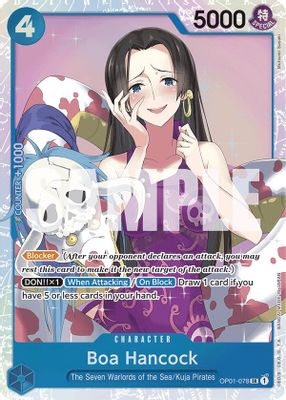
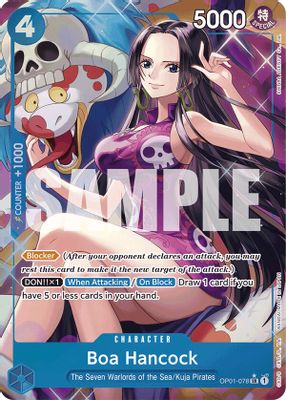
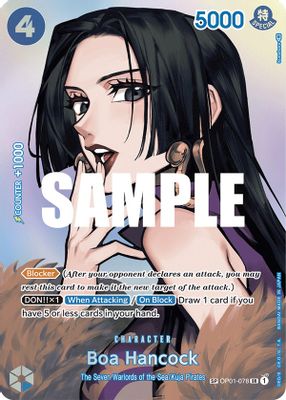
TCGplayer market estimates. Condition and grading affect value.
 OneDex FOR IPHONE
Your next chapter starts with a scan.
Put your collecting plans into practice. Scan your cards, organise what you own and follow your collection’s value with OneDex.
Scan · Collect · Follow its value
Download on the App StoreTake a look inside